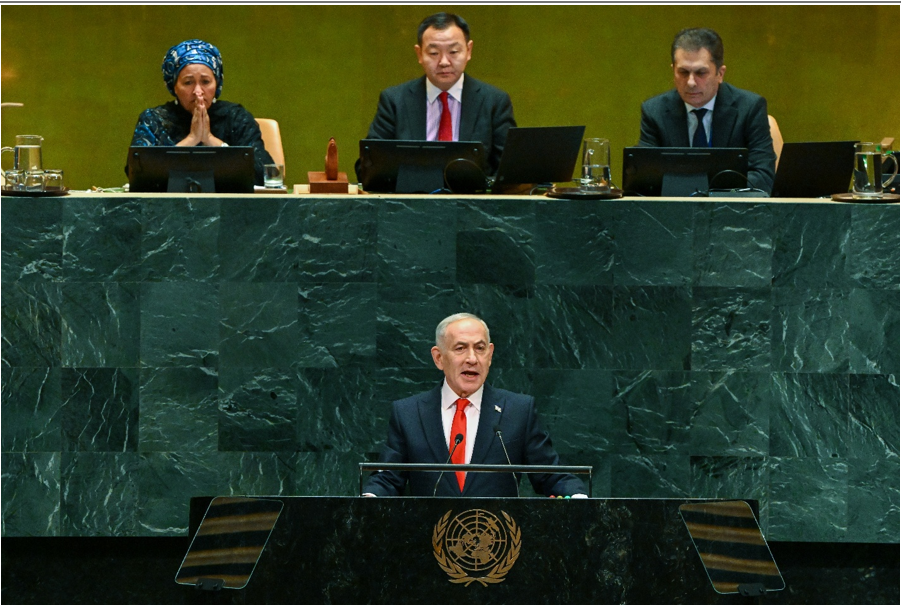
NEW YORK — In diplomacy, there are a thousand ways to express disagreement. One can issue a carefully worded statement. One can recall an ambassador. One can vote against a resolution. One can multiply declarations of “deep concern,” the favorite phrase of a diplomatic world that sometimes seems to believe that adding the word deep is enough to solve a crisis. And then there is a much simpler method: stand up, turn your back, and leave.
That is the image that marked Israeli Prime Minister Benjamin Netanyahu’s appearance before the United Nations General Assembly in New York. As he spoke, dozens of delegates left the hall. Netanyahu had the microphone. They had the door. And for a few moments, the door may have spoken louder than the microphone.
Let us be precise. The United Nations did not expel Benjamin Netanyahu. His address was not canceled. Israel was not denied its right to speak. Many delegations remained in the hall. But some representatives deliberately chose to leave their seats during his address. This distinction is essential. It was not an institutional sanction. It was a political and symbolic protest. And in diplomacy, symbolism can sometimes wield extraordinary power.
An empty chair delivers no speech.
It does not shout.
It does not vote.
It issues no statement.
Yet when empty chairs become numerous, they can send a message that no one in the room can pretend not to have seen.
That may be the most remarkable irony of this scene.
The diplomats who left did not have the microphone.
They did not have the podium.
They were not the central figures in that moment.
And yet their departure became an important part of the story.
They left the room in order to be heard.
What a strange diplomatic age.
For decades, taking the floor at the United Nations represented the ultimate opportunity for a country to make its position heard. Today, sometimes, refusing to listen becomes a speech in itself.
Not a word.
Not a sentence.
Not even a comma.
Just an exit.
It would be tempting to reduce the scene to four words:
“Netanyahu humiliated at the UN.”
It would be dramatic. It would probably be highly shareable. But it would also be too simplistic.
The real question is far more interesting. Who did this scene truly put in a difficult position?
Benjamin Netanyahu, confronted with a visible display of rejection by some of the representatives present?
The diplomats who preferred to leave rather than remain and listen to a leader with whom they profoundly disagree?
Or the United Nations itself, whose very purpose is precisely to sustain dialogue among states that sometimes can barely tolerate one another?
Consider this for a moment. If adversaries can no longer remain in the same room for a few minutes, how will they ever remain around the same negotiating table for several hours?
That is the far more troubling question.
Benjamin Netanyahu did not, of course, arrive in New York in a political vacuum.
He arrived with Gaza.
With the war.
With the hostages.
With Israeli deaths.
With Palestinian deaths.
With the destruction.
With the accusations directed at his government.
With international criticism.
With questions about the future of the Palestinians.
With deep divisions over the conduct of the war.
In other words, when he stepped to the podium, he was not merely Benjamin Netanyahu. In the eyes of both his supporters and his critics, he embodied several years of a confrontation that has become one of the most explosive and emotionally charged issues in international politics.
That is why some stayed. That is why others left. And that is why every movement in that hall carried political meaning.
Netanyahu may have prepared a detailed speech. His advisers may have worked over every sentence. Every argument may have been rehearsed. Every message may have been strategically positioned.
But modern political communication obeys one unforgiving rule: an image can destroy in seconds the narrative control that a speech tries to build over an hour.
A leader at the podium.
Diplomats standing up.
Representatives heading toward the exits.
Rows of seats emptying.
It is an image immediately understood in Lagos, Johannesburg, Paris, Washington, Yaoundé, Dakar, or Nairobi.
No translation required. No fifty-page geopolitical analysis required.
The image asks the question by itself: What just happened?
And in the age of social media, that question can sometimes matter more than the speech itself.
This is where USAFRICA NEWS must go further.
Because it would be far too comfortable to applaud every walkout automatically without asking another question.
If leaving the room becomes a means of protesting a government’s policies, will that principle be applied with the same determination to every government?
That is the uncomfortable question.
When other leaders accused of serious human-rights violations take the floor, do the same delegations systematically stand up and leave? When major economic interests are at stake, does outrage retain the same intensity? When the country concerned is a strategic ally, do principles remain equally inflexible? When victims are far from Western cameras, does their suffering produce the same dramatic gestures?
This is where international morality often meets its oldest adversary: interests.
Human rights should not depend on the victims’ passports. International law should not change its definition according to the name of the country in the dock. And the international conscience should not operate with a switch: ON for adversaries. OFF for allies.
We must also reject the trap of believing that every discussion must necessarily choose only one people.
Recognizing Israel’s right to live in security should not require ignoring Palestinian suffering. Defending Palestinian rights should not mean minimizing attacks against Israeli civilians. Condemning terrorism does not mean giving a government a blank check. Criticizing the Netanyahu government does not mean condemning the Israeli people. Defending Palestinians does not mean defending every organization that claims to act in their name.
These distinctions are indispensable. Because when politics turns entire populations into extensions of their governments, civilians are usually the ones who pay the price.
Africa should watch this scene very carefully. But it should not simply choose among slogans produced elsewhere.
The continent maintains relations with Israel. It has historical relations with Palestine. It works with the United States, Europe, Arab countries, Iran, and many other powers.
Why, then, should Africa’s position be a photocopy of Washington, Brussels, Moscow, Beijing, or Tehran?
Africa must think for itself. It must defend civilians. It must defend international law. It must condemn terrorism. It must denounce serious violations when they occur. And above all, it must apply those principles regardless of the identity of the violator.
An Israeli life is not worth more than a Palestinian life. A Palestinian life is not worth more than an Israeli life. And an African life certainly should not become less important simply because it is lost far from the spotlights of Manhattan.
Ultimately, this episode raises a question that goes far beyond Netanyahu.
What is the General Assembly still for? Is it a place where adversaries come to listen to one another? A place where they simply recite their positions? Or is it gradually becoming a vast global stage where each delegation creates its own political moment before walking away?
The United Nations has never been a place of harmony. Nor was it ever designed to be one. It exists precisely because states disagree. If everyone were friends, there would be no need for the United Nations.
The real test of multilateralism, therefore, is not bringing together those who like one another. It is keeping in the same room those who can no longer stand one another.
That is why this collective walkout deserves more than a sensational headline. It is also a symptom of an international diplomacy that is profoundly unwell.
There is, nevertheless, something almost brutally simple about this scene.
Netanyahu had the right to speak. The others had the right not to stay.
That, too, is diplomacy.
The right to speak is not the right to be applauded. The right to take the podium does not oblige anyone to approve of what you say.
But refusing to listen also carries a responsibility.
Because sooner or later, after the wars, after the accusations, after the sanctions, after the boycotts, and after the theatrical walkouts, someone will have to return to a room. Someone will have to sit down. Someone will have to listen. And someone will have to negotiate.
So no, we will not reduce this scene to:
“Netanyahu humiliated at the UN.”
That would miss the point.
What we witnessed was far more troubling.
We saw a prime minister take the podium at the organization created to enable nations to speak to one another while some representatives chose, precisely, not to listen anymore.
We saw the depth of the rejection facing the Netanyahu government among part of the international community.
But we also saw the limits of a global diplomatic system in which symbolic gestures sometimes threaten to replace conversation.
So here is the question USAFRICA NEWS asks its readers:
WHEN DIPLOMATS PREFER THE DOOR TO A PRIME MINISTER’S SPEECH, WHO HAS REALLY LOST?
Netanyahu? Those who walked out? The United Nations? Or diplomacy itself?
One thing is certain.
Netanyahu had the microphone. His critics had the door. And for a few minutes in New York, the empty seats spoke without uttering a single word.
USAFRICA NEWS INC.
New York — Africa — Diaspora — The World Seen Differently.


