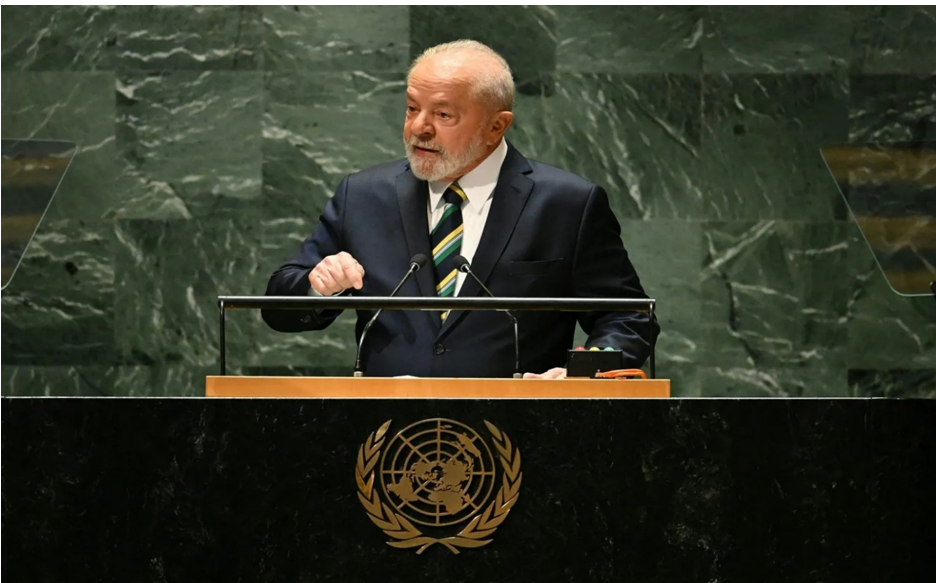
NEW YORK — At the United Nations General Assembly, some leaders come to deliver speeches. Others come to defend positions. And every so often, a head of state decides to remind the world’s major powers of a truth they would rather hear whispered than proclaimed from the podium.
This year, Brazilian President Luiz Inácio Lula da Silva chose to say it loudly enough for everyone to hear.
Confronting a Donald Trump-led America that openly places its national interests first, Lula delivered a message whose intended audience was difficult to mistake: “Brazil is not anyone’s backyard, and its democracy is not a file to be managed from Washington.”
Lula did not even need to mention Trump by name. Perhaps that was the most elegant part of the exercise. “BRAZIL IS NOBODY’S BACKYARD”
The message landed forcefully inside the halls of the United Nations. Lula made clear that Brazil would not accept being treated as part of another power’s sphere of control. Behind that declaration lies an old and uncomfortable question that has haunted relations between Washington and Latin America for generations: Are nations of the Global South truly sovereign or are they sovereign only when their decisions align with the interests of the world’s most powerful countries?
That is the question that makes people uncomfortable. Washington readily invokes sovereignty when defending its own borders, institutions, elections, and strategic interests. But what happens when another country demands exactly the same respect? Suddenly, the principle appears far more complicated.
Lula also warned against foreign attempts to interfere in Brazil’s electoral process at a particularly sensitive political moment. In plain language: “Brazilians will decide who governs Brazil.” A revolutionary concept? It should not be. Yet in geopolitics, even the obvious can become subversive when spoken by the “wrong” country in front of the “right” superpower.
Donald Trump has never hidden his governing philosophy: “America First.” At the United Nations, the U.S. president once again defended a worldview centered on American strength, national sovereignty, and deep skepticism toward parts of the international multilateral system. Fair enough. But Lula’s position raises a far more uncomfortable question: If America has the right to put America first, why should Brazil not have the right to put Brazil first?
And why should Africa not be allowed to put Africa first? Why should Caribbean nations not defend their own priorities? Why should countries of the Global South applaud the patriotism of powerful nations while being accused of defiance when they defend their own national interests? There lies one of the fundamental contradictions of today’s international system.
The issue extends far beyond Trump and Lula. It goes to the heart of how the international order functions.
Major powers frequently invoke international law when it protects their interests, only to rediscover the virtues of “national interest” when those same rules become inconvenient. They defend non-interference especially when their own affairs are involved. They demand respect for borders while retaining enormous economic, diplomatic, and political leverage over countries elsewhere. But “sovereignty cannot operate like an exclusive VIP lounge: unlimited access for a privileged few, while everyone else waits behind the velvet rope.” That is precisely why Lula’s message extends far beyond Brazil.
This is where Lula’s intervention should resonate particularly strongly across Africa. Because this debate is African, too. For decades, African leaders and citizens have heard lectures about democracy, good governance, human rights, transparency, and sovereignty. Those principles matter. They should matter everywhere. But Africa must also have the courage to ask: Who writes the rules? Who decides when those rules apply? Why do some crises trigger sanctions, emergency summits, and international outrage while others disappear into years of diplomatic indifference? Why does Africa, home to more than a billion people, still have no permanent seat on the United Nations Security Council?
That last question becomes increasingly difficult to avoid for anyone claiming to defend a truly representative international order. Calls for Security Council reform and greater representation for Africa and other historically underrepresented regions continue to expose one of the most obvious contradictions of the current global architecture.
The world is changing. Slowly at times. Violently at others. But undeniably. Brazil is speaking more assertively. India is defending its interests. Africa is demanding fairer representation. Middle powers are seeking greater strategic autonomy. And much of the Global South is increasingly rejecting the assumption that a handful of capitals should retain the authority to define, on behalf of everyone else, what democracy, security, justice, and international order are supposed to mean. That does not mean Lula has all the answers. It certainly does not mean Brazil is free of contradictions. But on one point, his message deserves attention:“Respect cannot be a one-way street.” A nation cannot demand independence for itself while expecting obedience from everyone else.
The symbolism of the UN General Assembly was difficult to miss. Lula and Trump addressed the gathering one after the other, consistent with the longstanding tradition in which Brazil opens the General Debate before the host country, the United States, takes the floor. Two presidents. Two political philosophies. Two competing visions of global power. Trump presents an America determined to use its power aggressively in defense of its national interests. Lula responds with sovereignty, multilateralism, and resistance to foreign interference. One says, in essence: “America First.” The other responds: “Brazil is nobody’s backyard”. And behind this exchange lies perhaps one of the defining questions confronting the international community: In the emerging world order, who still gets to tell whom what to do?
At USAFRICA NEWS, we reject the simplistic narrative in which Lula must automatically be cast as the hero and Trump automatically as the villain. Geopolitics deserves better than spectators choosing teams from the bleachers. But it also deserves better than silence. When the leader of a major Global South nation reminds the world’s most powerful countries that sovereignty is not their private property, that argument deserves serious attention. Because tomorrow, Brazil may not be the only country asking these questions. Africa will ask them. The Caribbean will ask them. Emerging nations will ask them.
And perhaps one day, in the polished corridors of New York, Washington, Moscow, Beijing, Paris, and London, the world’s major powers will finally have to answer an extraordinarily simple question: “If all nations are sovereign, why do some still appear to be more sovereign than others?” Lula may not have phrased the question exactly that way. But after his appearance at the United Nations, the question is hanging in the air. And it may continue to make powerful capitals uncomfortable for a very long time.
USAFRICA NEWS INC.
New York — Africa — Diaspora — The World From a Different Perspective.


