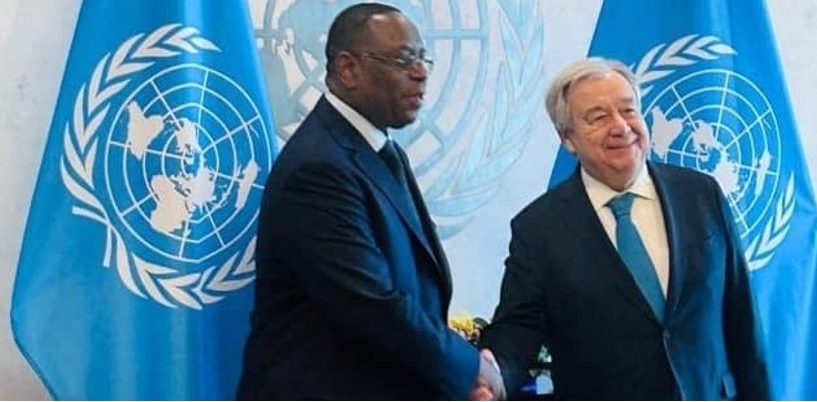
It was bound to happen on the grand stage of global ambition, Africa, an eternal power in the making, once again finds itself debating… itself. And at the center of this carefully dissonant diplomatic choreography stands one man: Macky Sall, former president of Senegal, now aspiring to one of the most coveted thrones on the planet, the Secretary-Generalship of the United Nations.
On paper, everything seemed straightforward. The African Union, ever faithful to its rhetoric of continental unity, could have rolled out the red carpet for its candidate, raised high the banner of a single African voice, and sent the world a clear message: “Here is our champion.” But between rhetoric and reality lies that persistent detail is called realpolitik.
For in the air-conditioned salons of Addis Ababa, the unofficial capital of grand African aspirations, support for Macky Sall looks less like a triumphant march and more like a hesitant dance. Here, one state clears its throat discreetly. There, another raises a skeptical eyebrow. Elsewhere, some wonder, not without irony: must Africa truly discover a passion for unanimity… precisely now?
The so-called “silence procedure” that bureaucratic marvel, where the absence of objection equals approval, has thus turned into a delicate balancing act. A silence that, far from being serene, echoes like contained noise. For everyone knows that in such matters, what remains unsaid often speaks louder than official statements.
And how could it be otherwise? Africa, this continent of 54 voices, is not a harmonious choir but a complex, sometimes dissonant polyphony. Behind every position lie subtle calculations, regional rivalries, and that lingering question: why him and not me, or at least one of my own?
Meanwhile, on the global stage, the great powers watch closely. While the United Nations likes to cloak itself in the garments of multilateralism, everyone understands that choosing its Secretary-General is less a popularity contest than a chess game among the permanent members of the Security Council. In other words, even a candidate enthusiastically endorsed by the African Union would still be just one contender in an arena where the rules are never fully written.
As for Macky Sall himself, he moves forward, unperturbed, carried by the quiet confidence of those who have already stood at the heights of power. Yet his political shadow travels with him: domestic tensions, criticisms of governance, memories still fresh for some of his African peers. Details diplomacy never mentions… but never forgets.
Thus, this deliciously paradoxical tableau emerges: an Africa that proclaims its unity while constantly negotiating it; a candidacy both supported and contested; a silence that makes noise.
And in the end, one question remains simple in appearance, formidable in implication: does Africa truly want to speak with one voice, or does it prefer to keep debating the tone it should adopt?
In this almost Shakespearean drama, one certainly endures whatever the outcome, the world will be listening. Perhaps not always to what Africa says, but certainly to how it hesitates to say it.


