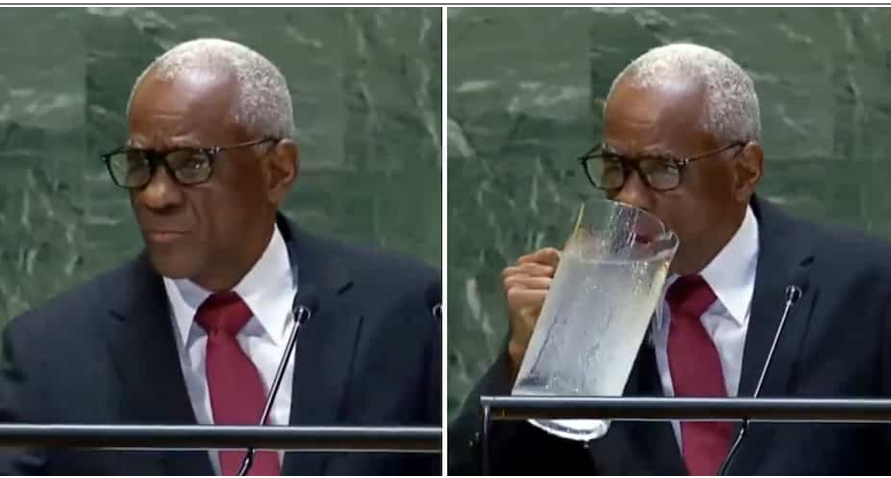
NEW YORK — There are moments when History enters a room with a roar. And there are others when it arrives with nothing more than a water pitcher.
Haitian Prime Minister Alix Didier Fils-Aimé came to the 81st session of the United Nations General Assembly with a far more serious mission: to speak about Haiti before the world.
And he had plenty to say.
Haiti no longer wants to be viewed solely through the lens of gangs, kidnappings, political crises, poverty, and disasters. The Prime Minister presented the image of a country determined to reclaim its place, its sovereignty, its security, and, above all, the respect it is due.
On substance, that demand is difficult to dispute.
Haiti is a founding member of the United Nations, and Fils-Aimé recalled that historic role during his address. He also urged the international community to look beyond the images of crisis that too often define his country.
Then came… the pitcher.
According to the images at the center of this column, after his address, the Prime Minister picks up the large water pitcher placed before him and drinks directly from it.
An ordinary gesture?
Probably.
A diplomatic crime?
Certainly not.
But in the age of social media, when a few seconds of video can travel faster than a twenty-minute speech, small details can be particularly unforgiving.
And therein lies the paradox.
You have just asked the world to see your country differently.
You have just spoken about dignity.
You have just reminded the world of Haiti’s historic importance.
You have just demanded, in essence, that the international community stop treating your nation as a permanent emergency room.
And moments later, the Internet may no longer be discussing security, elections, investment, or sovereignty.
It is watching… the pitcher.
Welcome to diplomacy in the twenty-first century.
Perhaps that is unfair.
But international politics has never promised to be kind to images.
A leader can spend weeks preparing an address.
Advisers can revise every comma.
Diplomats can weigh every expression.
Communications teams can craft every message.
And then come five seconds that were never part of the plan.
Five seconds.
A phone records them.
Someone posts them.
Someone else adds a caption.
Then come the comments, edits, jokes, and outrage.
And suddenly, the detail threatens to swallow the speech.
That is precisely why representing a nation does not begin when the microphone is switched on—and does not end when it is switched off.
But caution is necessary.
It would be intellectually lazy—and frankly unfair—to reduce the Haitian Prime Minister’s appearance to a story about a glass or a water pitcher.
The real issue lies elsewhere.
Fils-Aimé spoke about a country attempting to emerge from a crisis of extraordinary severity. His address touched on security, institutional reconstruction, elections, investment, and international cooperation.
And this is precisely where USAFRICA NEWS wishes to ask a more uncomfortable question:
Can international respect truly be demanded from the podium when a state still struggles to guarantee that same respect to its own citizens in their daily lives?
Respect also begins in the streets.
In institutions that function.
In a police force capable of protecting people.
In a credible justice system.
In elections in which citizens can participate without fearing the guns.
In an administration that inspires confidence.
In a state that does not constantly need outsiders to perform the functions it should be capable of carrying out itself.
That is the real pitcher no one wants to look at.
Let us be very clear.
Mocking Haiti would be easy.
Too easy.
And USAFRICA NEWS will not confuse one individual gesture with the dignity of an entire people.
The Haitian people are not a water pitcher.
Haiti is not a meme.
Haiti is the nation of 1804, one of history’s great symbols of the struggle against slavery and colonial domination.
It is precisely because that history is so immense that the contrast with the present situation is so painful.
The fundamental issue, therefore, is not how a Prime Minister drinks water.
The issue is that, in 2026, Haiti still has to take the international stage to convince the world that it exists beyond its crisis.
And that should concern us far more than a water pitcher.
Yes, the image may make people smile.
Yes, social media may seize upon it.
Yes, for political leaders, protocol and control of their public image matter when they represent a nation on one of the world’s greatest diplomatic stages.
But let us turn the irony into a serious question.
What would it matter if the Prime Minister handled the water pitcher perfectly while, behind him, Haiti continued to lose control of its destiny?
That is the real debate.
Because a glass of water can be emptied in seconds.
A nation’s reputation, however, can take decades to rebuild.
And while the world watches the pitcher, Haiti is still waiting for the world to take a serious look at its future.


