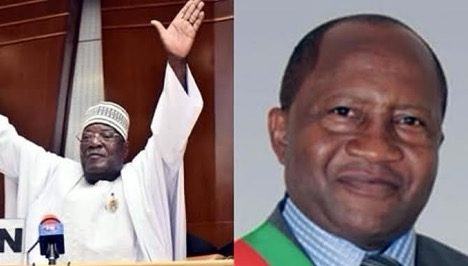
The extraordinary longevity of Cavayé Yéguié Djibril at the helm of the National Assembly of Cameroon defined an entire political era. For thirty-four years, he embodied the stability of a system firmly anchored to the authority of President Paul Biya. Yet in March 2026, that stability gave way to a transition as discreet as it was revealing.
Officially, his replacement is framed as part of a renewal process. At 86, the former Speaker had come to symbolize an aging political elite increasingly out of step with a population demanding change. But this explanation, while plausible, falls short of capturing the deeper forces behind his removal.
In reality, Cavayé’s departure is the culmination of a slow process of political erosion. Over the years, several initiatives deemed inappropriate weakened his standing. Perceived premature ambitions, sensitive public statements, and occasional missteps gradually eroded the trust he once enjoyed at the highest levels of the state. In a system where discipline and loyalty are paramount, even minor deviations can prove decisive.
The 2025 incident in Maroua, during which his public address caused discomfort and confusion, crystallized these doubts. More than a mere episode, it served as a turning point, revealing a political figure at the end of his cycle, whose continued presence had become increasingly difficult to sustain within a system seeking coherence and control.
Beyond the individual case, a broader strategy is clearly at play. Under the leadership of Paul Biya, Cameroon appears to be undergoing a gradual reconfiguration of its ruling elite. The objective is twofold: to preserve internal balances while quietly preparing a controlled generational transition. In this context, no position, no matter how symbolic, can remain indefinitely untouched.
Théodore Datouo: The Man Behind the Strategic Choice
The appointment of Théodore Datouo as head of the National Assembly is far from accidental. On the contrary, it reflects a carefully calibrated political calculation.
Less publicly visible than his predecessor, Datouo fits the profile of a system insider: discreet, disciplined, and widely regarded as loyal to the executive branch. His career, deeply rooted within the structures of power, makes him a trusted figure capable of ensuring continuity without provoking internal tensions.
His selection meets several strategic imperatives:
Where Cavayé embodied a form of entrenched, personalized power built over decades, Datouo represents a return to a more restrained and tightly managed institutional leadership.
A Telling Transition
The replacement of Cavayé Yéguié Djibril by Théodore Datouo goes beyond a simple change of individuals. It reflects a deeper evolution within Cameroon’s political system one in which longevity no longer guarantees permanence, and where loyalty, constantly reassessed, remains the cornerstone of power.
In a country where political balances are meticulously orchestrated, this transition may well signal further adjustments ahead. For beneath the calm surface of institutions, a broader process of transformation is quietly unfolding deliberate, controlled, and unmistakably strategic.


