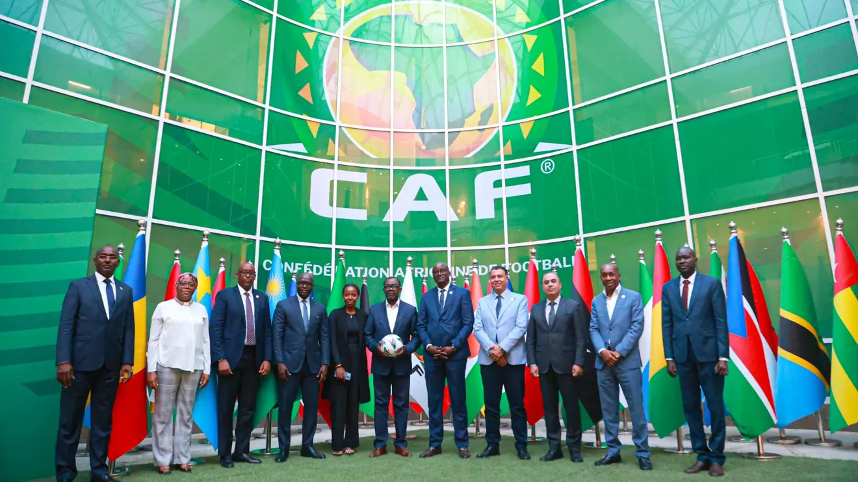
African football has just witnessed a spectacle its leaders seem particularly adept at staging: a sweeping reform announced with confidence, defended in the name of modernization, then abandoned before it had truly begun. On October 29, 2026, the Executive Committee of the Confederation of African Football (CAF) officially and unanimously decided to retain the Africa Cup of Nations (AFCON) on a two-year cycle.
End of the show. Back to square one.
Yet in December 2025, CAF President Patrice Motsepe had announced that AFCON would move to a four-year cycle beginning in 2028. The justification? Modernize African football, rethink its international calendar, and develop a new African Nations League. Less than a year later, however, the project was shown the red card. The officially stated reason was primarily economic: the proposed Nations League would not generate enough revenue quickly enough to replace AFCON’s earnings.
In other words, the plan was to halve the frequency of the competition that brings in money before establishing whether its replacement could earn as much. A strategy that might make even a first-year financial management student smile.
The Africa Cup of Nations is no ordinary competition. It is one of the continent’s premier sporting events, attracts millions of viewers and generates substantial commercial revenue. Broadcasting rights, sponsorships, advertising, partnerships, and economic benefits for host nations: AFCON supports an entire ecosystem.
It also helps finance CAF’s operations and football development across its 54 member associations. This raises an obvious question: how could the leaders of the pan-African governing body contemplate halving the frequency of their flagship competition without a financially proven replacement?
Granted, the proposed African Nations League was intended to maintain a regular continental showcase. But a competition that has yet to be built does not automatically possess the prestige, commercial value or loyal following of a historic tournament.
You cannot replace a beloved institution with a promise on a PowerPoint slide. CAF appears finally to have understood that. And this time, it was not a coach changing tactics at halftime: the entire administration of African football had to revise its playbook.
Behind this U-turn lies a deeper question: does African football truly control its own direction? For years, AFCON’s scheduling has created tensions with European clubs that must release their African players for international competitions. Moving from a biennial to a four-year tournament would have reduced the frequency of those absences.
That prospect could therefore have benefited clubs employing large numbers of African internationals. Critics consequently viewed the original reform as a concession to European football interests and an attempt to align with major international calendars.
Nevertheless, it would be unfair to claim without evidence that FIFA or UEFA imposed the reform. Patrice Motsepe himself rejected allegations that CAF takes its orders from those organizations. But the absence of evidence of direct interference does not prevent us from asking a legitimate question:
Why should the continent’s economic, cultural and sporting needs come second to the scheduling concerns of world football’s powerhouses? African players enrich numerous foreign leagues. They fill stadiums, attract sponsors and contribute to their clubs’ commercial strength. Why should their continental competition be treated as an inconvenience rather than a major event in world football? Africa is not asking for a favor. It is simply demanding the right to set its own priorities.
The proposed pan-African Nations League was supposed to be one of CAF’s major innovations. On paper, the idea sounded appealing: more competitive matches, better organization of national teams and new commercial opportunities. But a gulf can separate ambition from economic viability. In its official statement, CAF acknowledged that the competition would need several years before it could provide sufficiently significant financial resources for African football development.
That is precisely the problem.
Why attempt to change AFCON’s schedule before fully assessing whether the new competition could finance the system? The point is not to condemn innovation. African football needs fresh ideas, better-organized competitions and diversified revenue. But innovating without securing the underlying business model is not necessarily boldness. It may also reveal strategic recklessness. And when that recklessness concerns African football’s most prominent showcase, the consequences can extend far beyond CAF’s offices.
2027: Kenya, Tanzania and Uganda
2028: Host nation to be confirmed
2031: Host nation to be confirmed
2033: Host nation to be confirmed
CAF announced the editions on October 29, 2026. The general principle is a two-year cycle, but the announced years include adjustments. CAF confirmed that the next edition would take place in 2027 in Kenya, Tanzania and Uganda, followed by editions in 2028, 2031 and 2033. The absence of an announced 2030 edition is partly explained by the desire to accommodate the FIFA World Cup scheduled for that year. This calendar reveals another reality: retaining the principle of AFCON every two years does not necessarily mean observing a strict 24-month interval between tournaments.
CAF must therefore explain how it intends to ensure a stable schedule and give federations, broadcasters, sponsors and supporters long-term clarity. Modern football demands more than spectacular announcements followed by successive corrections.
With so much talk of commercial contracts, calendars and revenue, it is easy to forget those who give AFCON its true meaning: the African people. From Cameroon to Senegal, Côte d’Ivoire to Nigeria, Morocco to the Democratic Republic of the Congo, AFCON transcends sport. It electrifies neighborhoods, brings families together and transforms football matches into moments of national unity.
It also gives international visibility to players who do not necessarily compete in the most heavily publicized leagues. For many Africans, the tournament offers a chance to celebrate their identity, culture and shared continental belonging. Reducing its frequency could therefore never be treated as a mere administrative adjustment.
The public deserved transparent debate, rigorous economic analysis and convincing explanations. Instead, it witnessed a succession of contradictory decisions. Yesterday, four years represented the future. Today, two years embody wisdom. Tomorrow, will we have to check the financial weather forecast to learn the next tournament schedule?
Let us be fair: reversing a poor decision can show responsibility. It is better to correct a risky course than to persist out of institutional pride. On that point, CAF’s decision deserves recognition. But it also raises serious questions about the quality of its governance. An organization responsible for football across 54 national associations must show that major decisions rest on sound studies, thorough consultations, and credible financial forecasts. Yet the latest reversal suggests that economic realities were fully acknowledged after the reform was announced rather than before.
That impression deserves an explanation.
CAF should, in particular, publish the main findings of the financial analyses behind its change of direction. It should also clarify the outlook for the African Nations League and explain how it plans to diversify revenue without weakening AFCON. The real challenge is not merely to hold a competition every two years.
It is to build an institution capable of making coherent decisions, defending its members’ interests and resisting external economic pressures. African football has the talent, supporters, markets and history to command a major place in world sport. What it still too often lacks is governance equal to its potential.
By officially maintaining the Africa Cup of Nations every two years, CAF has made an important decision to preserve the continuity of its flagship competition. But this reversal will also stand as a revealing episode in the contradictions of African football governance. The move to a four-year cycle had been presented as a reform for the future. Just months later, economic reality forced a change of course.
Money is not football’s enemy. It builds stadiums, funds competitions, supports federations and develops talent. But when it becomes the sole referee of decisions, the sport risks losing what makes it great.
AFCON is not a commodity to be stored in a warehouse for four years and brought out again when the accounts look favorable. It belongs first and foremost to history, the players, and the peoples of Africa. That CAF has finally understood this is good news. That such a dramatic reversal was needed to get there is far less reassuring. And ultimately, one question remains: Is CAF truly guiding African football with a strategic vision, or is it simply waiting for the numbers in its accounts to tell it which way to run? In this match, the African public is still waiting for an answer.


