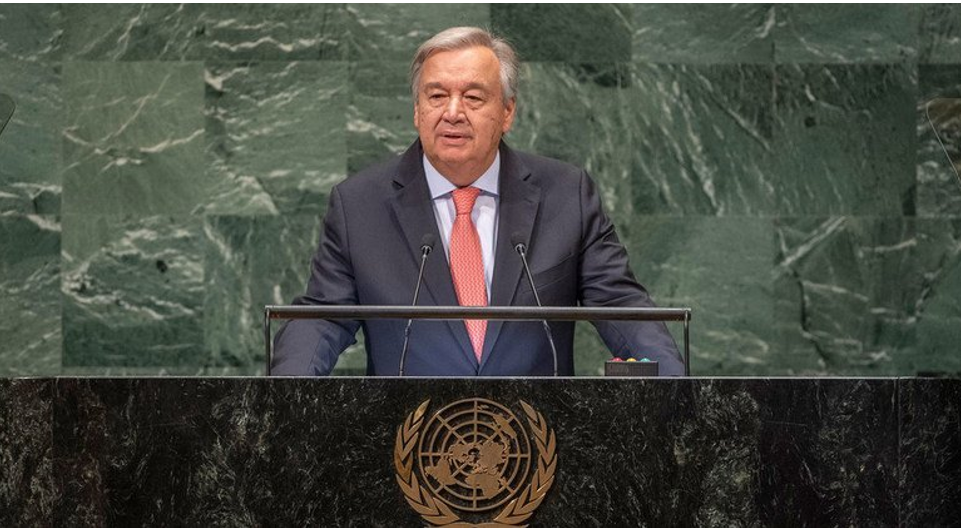
It took until 2026 for an obvious truth to be proclaimed once again with such clarity at the heart of the United Nations: the international community cannot reasonably claim to manage the world order of the twenty-first century through a power structure largely inherited from the aftermath of World War II. At the opening of the general debate of the 81st session of the United Nations General Assembly in New York, Secretary-General António Guterres brought one of the organization’s most persistent contradictions back to the center of the international stage: Africa still has no permanent seat on the Security Council.
For Guterres, the situation is now “unjust and indefensible.” He argued that the Council must be reformed to better reflect today’s world and strengthen its legitimacy and effectiveness. That much has now been said. But for Africa, the real issue is no longer simply who recognizes the injustice. The question is who is genuinely prepared to change the rules that perpetuate it.
The Security Council has fifteen members. Five hold permanent seats: China, France, Russia, the United Kingdom and the United States. These five powers also hold the right of veto. Africa?
It participates. It debates. It contributes to the United Nations. Its crises regularly occupy the international agenda. African states can win non-permanent seats. But when it comes to the Council’s most powerful category, permanent membership, the continent remains outside. The situation becomes particularly difficult to defend when viewed in its historical context.
When the United Nations was created in 1945, much of Africa was still under colonial rule. The institutional structure born in that era has survived for eight decades, while the world itself has changed profoundly. Colonial empires have fallen. Dozens of African states have gained independence. Africa today accounts for 54 United Nations member states. And yet, in the permanent category of the Security Council, Africa’s tally remains the same: zero.
The world has changed. The room, it seems, forgot to change the chairs.
This is perhaps where the contradiction is most striking. Africa is regularly at the center of international discussions on peace, conflict, terrorism, population displacement, development, food security and climate change. The continent also contributes to international efforts to maintain peace and security. Yet when the time comes to sit permanently at the table where some of the world’s most consequential security decisions are made, not one permanent chair bears Africa’s name.
One could almost smile at the irony if the stakes were not so serious. Africa is important enough to be discussed, but not yet sufficiently represented to have a permanent voice within the circle where a veto can determine the fate of a resolution. That is precisely the contradiction that calls for reform to correct.
Africa’s common position is not simply a symbolic demand for “a place” at the table. In negotiations on Security Council reform, Africa has called for at least two permanent seats and five additional non-permanent seats for the continent. It has also demanded that new African permanent members receive the same prerogatives as the existing permanent members, including the veto, for as long as that power continues to exist.
In other words, the issue goes far beyond a diplomatic photo opportunity.
Giving two African representatives permanent seats while denying them the powers granted to the other permanent members would create a two-tier form of permanence: permanent members who can block a decision, and permanent members whose permanence would exist mainly on their nameplates. That would be quite a reform. Especially for changing almost nothing.
The Secretary-General’s statement carries genuine political and symbolic weight. It publicly reinforces the argument that the Council’s current composition no longer adequately reflects contemporary geopolitical realities.
But one distinction matters.
The Secretary-General cannot create new permanent seats through a speech. Meaningful reform of the Security Council requires an amendment to the United Nations Charter, demanding an exceptionally high level of agreement among member states and, crucially, acceptance by the five current permanent members. And this is where the discussion becomes considerably less poetic.
Reforming the Council necessarily means discussing the distribution of power. It is relatively easy to applaud the principle of a more representative United Nations. It is far more difficult to decide who receives a new chair, what powers come with that chair, and how the current holders of privilege agree to alter a system from which they themselves benefit.
Africa no longer needs only declarations affirming that it deserves permanent representation. It needs concrete institutional reform. African leaders will also carry a major responsibility: maintaining a sufficiently coherent common position so that national rivalries do not become the most convenient argument for those who would prefer to postpone reform indefinitely.
Once the principle of permanent African seats is accepted, an inevitably sensitive political question will arise: Who will represent Africa? ……. Nigeria? South Africa? Egypt? Another African power? Or seats allocated through a regional representation mechanism determined by the African Union? That debate will come. But it must not become the perfect excuse for preserving the status quo.
António Guterres’s statement therefore places a fundamental question before the international community. Can an institution credibly claim a universal mission when one of the world’s major regions remains absent from its most powerful category of permanent membership? The Secretary-General has given his answer: the situation is unjust and indefensible…. Words are no longer enough; After more than eight decades, Africa does not need another promise carefully applauded in the corridors of Manhattan. It needs a chair; A real chair; With the same rights as the others. And above all, a chair that does not disappear when the applause at the General Assembly comes to an end.
Ultimately, this debate extends beyond Africa. It concerns the credibility of the multilateral system itself. Either the Security Council evolves to better reflect the world it claims to represent, or the gap will continue to widen between the United Nations’ proclaimed ideal of equality and the actual distribution of power within its most influential body.
António Guterres has brought the issue back into the spotlight. Africa, however, has known the problem for a very long time. The question is no longer whether Africa’s exclusion from permanent membership is difficult to defend. The question is how many more generations of Africans must hear that it “must change” before they actually see it change.


