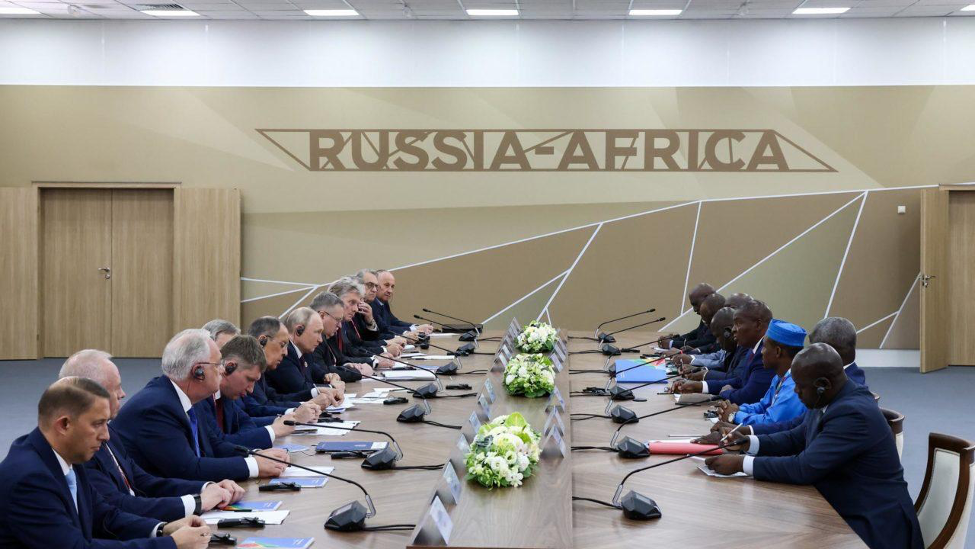
MOSCOW: A NEW STAGE FOR AFRICAN AMBITIONS
Moscow is hosting the third Russia–Africa Summit at a time when major powers are competing to consolidate their economic, diplomatic, and strategic positions. Following Sochi in 2019 and St. Petersburg in 2023, this latest gathering seeks to deepen relations between Russia and African states in areas as vital as trade, energy, agriculture, infrastructure, security, education, and technology.
On paper, the opportunities are plentiful. But behind the official ceremonies, declarations of friendship, and carefully photographed smiles, one question remains: What will African people actually gain? They have heard this tune before. Prestigious summits? They know them. Ambitious communiqués? They know them too. Announced billions, memoranda of understanding, and grand promises of cooperation? All painfully familiar.
What they want now are results. Lasting jobs. Infrastructure that works. Industries capable of processing local resources. Investments that improve living standards. In short, cooperation whose benefits extend beyond the gates of presidential palaces.
PUTIN INVOKES THOMAS SANKARA: AFRICA’S DEBT AT THE HEART OF THE DEBATE
One of the most striking elements of Russia’s political message is its reference to Thomas Sankara, Burkina Faso’s former revolutionary president. In denouncing the mechanisms of international indebtedness, Vladimir Putin echoes a criticism Sankara famously advanced: Debt can become an instrument of domination when it restricts states’ economic and political freedom. In 1987, at the Organization of African Unity summit in Addis Ababa, Sankara urged his fellow leaders to confront the burden of debt and its consequences for African sovereignty. Nearly four decades later, the issue remains remarkably relevant.
In several African countries, debt repayments consume public resources that could otherwise fund schools, hospitals, roads, agricultural equipment, and productive investment. Moscow’s criticism focuses particularly on the terms of certain international financing arrangements, trade imbalances, and mechanisms that may constrain African governments’ economic choices. Yet an uncomfortable question must be asked: Is denouncing the chains of dependence enough to prove a genuine desire to break them?
Thomas Sankara was not merely calling for one international partner to be replaced by another. He advocated a profound transformation in how Africans produce, consume, govern, and make decisions. His legacy deserves better than becoming another rhetorical weapon in the rivalry between Moscow and Western capitals.
AN AFRICA RICH IN RESOURCES, YET STILL GRAPPLING WITH DEPENDENCE
Africa’s economic paradox is difficult to ignore. The continent possesses vast agricultural, mineral, and energy resources. Yet many of its economies remain heavily dependent on exporting raw materials and importing finished goods. Some countries export crude oil only to import part of the fuel they need. Others produce cocoa, cotton, or minerals without the industrial capacity to capture a sufficient share of the value generated from those resources.
Meanwhile, debt continues to weigh on national budgets. Should Western creditors alone be blamed? That would be far too convenient an analysis. African debt now involves multilateral institutions, private banks, and a range of bilateral partners, both Western and non-Western. Decisions made within African states themselves must also be scrutinized. Poor public-finance management, badly designed projects, corruption, and a lack of transparency can significantly worsen economic difficulties. There is a particular irony in loudly condemning international mechanisms of domination while refusing to examine domestic responsibility. Africa will not build economic sovereignty by looking only beyond its borders. It must also rigorously examine how its own resources are managed.
WHAT CAN AFRICA REALLY GAIN FROM ITS PARTNERSHIP WITH RUSSIA?
Closer ties with Moscow open several possibilities for economic and technical cooperation. In the energy sector, Russia has expertise in hydrocarbons, electricity infrastructure, and civilian nuclear power. Egypt’s El Dabaa nuclear power plant is a concrete example of cooperation in this field. In agriculture, Russian grain and fertilizer exports can help supply certain African markets.
University, scientific, and technological partnerships can also support specialist training and the development of local expertise. Diversifying trade relations gives African governments a wider choice of partners. But possibilities must not be confused with results. A nuclear power plant does not automatically become an instrument of energy independence simply because it is built by a foreign partner.
It must also be accompanied by skills transfers, sustainable financing terms, technical training, and genuine national management capacity. Likewise, an agricultural agreement does not, by itself, guarantee food security. A commercial contract does not necessarily create a domestic industry. And a diplomatic communiqué, however elegantly worded, can never substitute for economic policy. The real value of a partnership must be measured by what it enables Africans to produce, control, and develop for themselves.
MOSCOW CRITICIZES THE WEST, BUT RUSSIA HAS INTERESTS OF ITS OWN
Russia portrays its cooperation with African countries as a relationship based on respect for sovereignty and rejection of neocolonialism. That message resonates in several African societies, particularly where historical relations with certain Western powers remain contentious. But international relations do not operate on generous declarations alone. Moscow has interests of its own.
Russia wants to expand its markets, strengthen its diplomatic alliances, increase its international presence, and deepen its economic and security partnerships. Russian military cooperation with certain African states has also generated controversy over civilian protection, security operations, and the accountability of forces on the ground. These issues require serious examination, without assuming that either accusations or denials are sufficient to establish the facts.
The same standard should apply to all Africa’s partners: Russia, the United States, the European Union, China, and other powers. An international relationship does not automatically become fair merely because it presents itself as an alternative to another. Independence is not about changing creditors, suppliers, or protectors. It is about having the means to choose freely, negotiate fairly, and defend one’s interests.
AND WHAT ABOUT AFRICAN LEADERS?
Here is the question official speeches sometimes approach with considerably less enthusiasm. It is legitimate to examine the historical consequences of colonialism and the persistent imbalances of the global economy. But that analysis cannot serve as a universal explanation for every difficulty on the continent. Why do some essential infrastructure projects remain unfinished despite substantial financing? Why do countries endowed with significant natural resources still struggle to develop competitive local industries?
Why do citizens sometimes know so little about the financial terms of major contracts signed in their name? And why do governments so rarely publish detailed assessments comparing the promises made at international summits with the results achieved? It would be unfair to suggest that all African countries face identical problems. Economic and institutional trajectories vary considerably from one state to another.
But one requirement remains universal: accountability. A government that claims sovereignty must be able to explain how it uses national resources, how it negotiates partnerships, and what benefits citizens can reasonably expect. Sovereignty is not merely a speech delivered before foreign cameras. It is also a responsibility exercised every day before one’s own people.
THOMAS SANKARA WAS NOT CALLING FOR A NEW PROTECTOR
The invocation of Thomas Sankara in Moscow is a reminder of how deeply debates over debt and economic independence are rooted in African political history. Sankara championed productive self-reliance, national dignity, and African peoples’ ability to shape their own development. His thinking went beyond denouncing foreign powers. It also urged African societies to reconsider their economic priorities, consumption patterns, and collective responsibilities. The question, then, is not simply who quotes Thomas Sankara today.
It is who actually helps put his principles into practice. Developing domestic production, supporting local businesses, strengthening agriculture, investing in scientific education, improving governance, and negotiating transparent contracts: these are tangible objectives. Historical references have their greatest value when they inform decisions and achievements, rather than merely lending force to a speech.
AFTER THE SPEECHES COMES THE MOMENT OF ACCOUNTABILITY
The third Russia–Africa Summit may strengthen existing cooperation and launch new projects. But its importance will not be measured by the number of official statements or the length of diplomatic communiqués. It will depend on commitments actually fulfilled. How many investments will materialize? How many sustainable jobs will be created?
What role will African businesses play in the announced projects? What transfers of technology and expertise will be guaranteed? What financial obligations will states assume? Above all, how will ordinary people be able to verify that promises have been kept?
These questions should guide the evaluation of the agreements. Economic diplomacy cannot be reduced to a succession of prestigious ceremonies whose benefits are difficult to identify. It must produce specific commitments, measurable outcomes, and information accessible to citizens.
AFRICA DOES NOT NEED A NEW MASTER; IT NEEDS THE MEANS TO EXERCISE ITS SOVEREIGNTY
The third Russia–Africa Summit brings fundamental issues back to the forefront: debt, neocolonialism, diversification of partnerships, and the continent’s economic sovereignty. By invoking Thomas Sankara, Vladimir Putin recalls a legacy that continues to shape African debates on independence and development. But the words spoken in Moscow must be judged against the commitments made and the results delivered. Russia, like every other international partner, must be able to demonstrate the tangible benefits of its cooperation.
For their part, African governments must strengthen their institutions, develop industrial capacity, and ensure that national resources genuinely improve living conditions. Africa now has a more diverse range of potential partners. That diversity can enhance its negotiating power, provided it is supported by coherent economic policies and responsible governance. Africa will not achieve sovereignty simply because one foreign power condemns the practices of another. It will build sovereignty when it can choose its partners, control its resources, finance its priorities, and answer its own citizens.
That is the real challenge, far beyond the speeches delivered in Moscow. And perhaps it is the essential question Thomas Sankara’s legacy still invites us to ask.
USAFRICA NEWS — Your Independent Perspective on Africa and the World.


