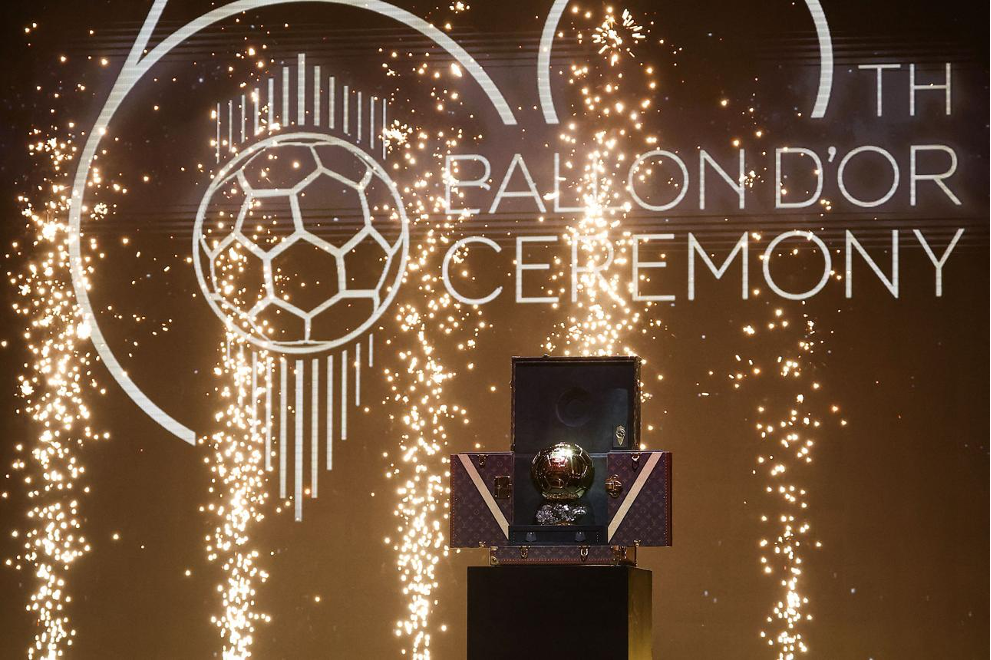
There was a time when the Ballon d’Or represented, in the public imagination, the ultimate recognition of footballing genius. Fans associated it with talent, consistency, extraordinary performances, and that almost supernatural ability to turn an ordinary match into a historic spectacle.
Today, an uncomfortable question keeps resurfacing: does the Ballon d’Or truly celebrate sporting excellence, or the art of manufacturing a media legend? In discussions about the favorites, the fact that players as gifted as Kylian Mbappé and Lamine Yamal do not consistently occupy the top two positions in predictions is enough to rekindle supporters’ suspicions. But since when has football been reduced to a publicity campaign, a collection of team trophies, or the media power of a club? To be clear, this is not to suggest that Mbappé and Yamal are automatically entitled to the award. Their rivals may have entirely legitimate sporting arguments in their favor.
The real question lies elsewhere: are the criteria applied with equal rigor to every candidate, or does their interpretation shift with circumstances? This is precisely where the ghost of an old controversy reappears: Samuel Eto’o and Fabio Cannavaro in 2006.
In 2006, Samuel Eto’o was at the height of his powers. The Cameroonian striker had helped FC Barcelona win the Champions League, having also secured the Spanish league title. Yet when the Ballon d’Or was awarded, the verdict was different: Fabio Cannavaro, the Italian defender and World Cup champion, took the crown. Eto’o finished sixth, with 67 points to Cannavaro’s 173. For many admirers of African football, that decision remains a symbolic wound. How could such a formidable, decisive, spectacular striker finish so far from the top? Certainly, Cannavaro had won the World Cup with Italy. Certainly, his defensive leadership had been remarkable. But since when must individual footballing excellence automatically bow to the prestige of a team competition? The irony is almost exquisite: when a striker scores goals, he is reminded that football is a team sport. When a defender wins the World Cup, that collective success suddenly becomes a decisive individual argument. One might think the standards of merit sometimes stretch like elastic. Nevertheless, it would be historically irresponsible to claim, without evidence, that Cannavaro stole the award. The potential scandal is not proven fraud; it is the enduring impression that comparable performances can be judged through different lenses. And that question extends far beyond Samuel Eto’o.
Power, pace, and clinical finishing. Creativity, audacity, and the talent of a rising generation. Modern football has two figures whose abilities leave nobody indifferent: Kylian Mbappé and Lamine Yamal.
One embodies extraordinary attacking power. The other represents a fearless youth who sometimes seems to have learned to dribble before learning to walk. Yet the 2026 Ballon d’Or crowned another giant: Harry Kane, Bayern Munich’s English striker, who, according to the original article, was honored on October 26, 2026, ahead of rivals including Mbappé and Yamal. And let us be serious: Kane is no ceremonial guest invited merely to fill a seat.
His performances, consistency, goals, and team successes provide strong arguments in support of his victory. The issue, then, is not to deny his merits. It is to ask why supporters sometimes feel that the definition of the best player changes from year to year. When a player excels individually, trophies are demanded. When he wins trophies, statistics are demanded. When he has both, the importance of leadership, conduct, or influence on the game suddenly comes to the fore. Has the Ballon d’Or become an examination whose grading system changes depending on the candidate? Its organizers should take that question seriously.
Contrary to a common misconception, the Ballon d’Or is not awarded directly by FIFA, nor is it decided by a worldwide popular vote. According to the 2026 rules cited in the original article, the trophy is organized by France Football, with the ceremony co-organized with UEFA. The men’s winner is chosen by an international jury of 100 specialist journalists representing the highest-ranked countries in the FIFA rankings. The official criteria are ranked in order: individual performances, team achievements, and then class and fair play. On paper, the process looks serious. But a fundamental difficulty remains: how can such subjective notions as a player’s ability to impress be measured objectively? One journalist will prioritize goals; another, creativity; a third, the Champions League; a fourth, the World Cup. All may follow the rules and still reach opposite conclusions. This is where media campaigns, reputations, and grand sporting narratives can shape perceptions, even without improper interference in the vote. There is no need to imagine a secret meeting in a luxurious Paris hotel to understand how an award based on human judgment can provoke controversy. Sometimes a system need not be rigged to be open to criticism.
The history of the Ballon d’Or also raises a question of representation. For decades, its rules restricted eligibility. Until 1995, only European players could win. Eligibility was then extended to players of all nationalities competing in Europe, before expanding worldwide in 2007.
That history matters.
It reminds us that the Ballon d’Or built its prestige within a system that did not always recognize world football in all its diversity. George Weah, Samuel Eto’o, Didier Drogba, Mohamed Salah, Sadio Mané: these names testify to Africa’s immense contribution to football history. It would, however, be unfair to treat every defeat of an African candidate as proof of discrimination. Yet it would be equally naive to pretend that historical legacies, media portrayals, and differences in visibility have no bearing on how athletes’ reputations are formed. African talent does not need charity. It demands consistent standards and recognition commensurate with its achievements.
Has the Ballon d’Or Become an Industry of Prestige?
From Samuel Eto’o to Mbappé and Yamal: The Real Issue Is Trust
Gold Can Buy Prestige, but Never Universal Respect
USAFRICA NEWS — Because world football deserves more than crowns, red carpets, and polite applause. It also deserves uncomfortable questions.


